
Customer success story
INCA Portfolio Managers
From world-class Excel models to a national municipal-finance platform for South Africa.

Last updated July 2026
INCA Portfolio Managers (IPM) is a specialist advisory firm that has served South Africa’s municipal sector for more than two decades, helping local governments plan ten-year budgets, set fair utility tariffs, and fund essential infrastructure. For years that expertise lived in some of the most advanced Excel financial models in the sector, one of them independently reviewed by the World Bank. With Molnify, IPM turned those models into a secure, national-scale web platform without rewriting a single line of their calculation logic.
This story is also available as a written case study, reviewed and approved by INCA Portfolio Managers: download it as a PDF. Or, have a look at our YouTube video about INCA below.
The challenge
Decentralised spreadsheets could not scale to a nation
IPM’s models are not simple calculators. They are large predictive engines, built on cash-flow management theory, that weigh economic assumptions, demographic shifts, and complex tariff structures to find sustainable funding mixes. As demand for IPM’s services grew, distributing those Excel files to 6 metros and 30+ local municipalities by email and shared drives reached its breaking point.
- Version-control risk. There was no way to guarantee that every municipal CFO was working on the latest version of the model.
- Data fragmentation. Each municipality needs its own dataset, and pasting it into hundreds of separate files was slow and error-prone.
- A “do not touch” constraint. The logic represented decades of intellectual property, accepted by the National Treasury. Rewriting it in Python or C# was off the table on both cost and risk.
The goal
A tender most low-code platforms could not meet
In 2021, IPM issued a formal tender with requirements precise enough to rule out most standard low-code platforms. Five non-negotiables:
- Preserve the Excel logicRun natively on INCA’s existing Excel models, with no rewrite.
- Zero-code maintenanceIPM’s own analysts update the logic, without hiring software developers.
- Enterprise scaleUp to 300 named and 100 concurrent users.
- SQL integrationEach user’s data pulled dynamically from an SQL database on login.
- Rapid deliveryLive within five months.
Molnify was selected because it met every requirement, anchored by the one that mattered most: turning the existing Excel models into web applications without rewriting their logic.
The solution
The Excel models, delivered as a secure national platform
Molnify turned IPM’s spreadsheets into a professional web platform without rewriting the logic. Users move through clear workflow tabs (model setup, revenue, opex) while charts and tables update instantly as inputs change. When a municipal user logs in, Molnify loads their municipality’s data automatically from a dedicated SQL database that Molnify hosts in a secure, isolated cloud environment, including MSCOA-compliant National Treasury data and S&P Global market insight.
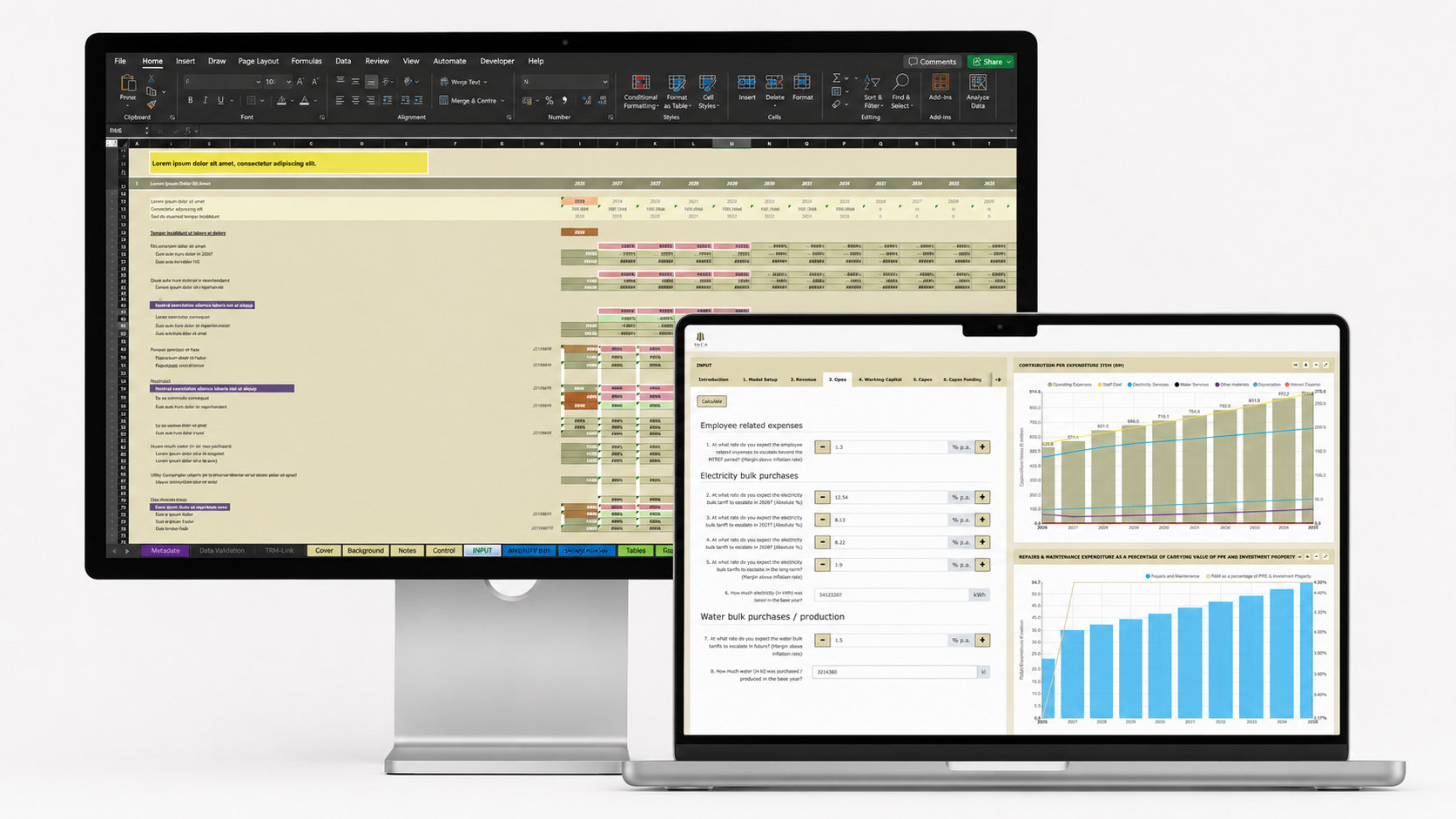
The platform hosts a connected suite of applications spanning the municipal financial lifecycle, anchored by two:
LTFM
Long-Term Financial Model
A ten-year forecasting and simulation tool, independently reviewed by the World Bank at the National Treasury’s request, that calculates how much infrastructure a municipality can sustainably afford.
TRFM
Tariff & Property Rates Model
A financial-sustainability engine that sets cost-reflective prices for electricity, water, sanitation, and solid waste across the MTREF period, down to the price per kWh or kL.
Five years on, the system is a staple of South African municipal finance. IPM owns 100% of its logic: a tariff formula is changed in Excel, not by a developer, and the firm can adapt to new National Treasury regulations in hours, not months.
“INCA has avoided technical debt entirely. When a regulation or tariff formula changes, its own analysts edit the logic in Excel and upload it, and the whole platform updates in hours, not months.”
From the INCA Portfolio Managers case study